

How Thai Automotive Industry New Challenges Would Need To Be Adapted To And Coped With In Order To Move Forward.

The Thai automotive industry has been developed for more than 60 years with a great many foreign investments to the extent of making Thailand becoming the leading automotive production center in the region nowadays. The factors of co-operations between Thailand and Japan have obviously tended to develop and grow continuously, thus, resulting in the past situation of the Thai automotive industry to apparently look promising and going well.
Yet, no one knows for sure whether the Thai automotive industry in the future can retain its greatness to be the automotive production center as before or not because the global automotive industry is about to change into the era of Electric Vehicles (EVs). Many nations are starting to wake up with the trends of EVs and on the jumps to compete in the automotive industry markets, especially, many Chinese EV brands that make announcements on their investments to establish EV production bases in Thailand. What would happen to the current Internal Combustion Engine (ICE) manufacturers and how far the EV production in Thailand would go, how the relevant new challenging situations in the automotive industry in Thailand would be and how the entrepreneurs should adapt themselves to be prepared for their readiness to cope with the upcoming changes, are becoming increasingly clearer. In this article, Ms. Sara Jongbanyatcharoen and Dr. Lalita Haruethaipan from LiB Consulting, a leading consulting company from Japan, invite everyone to do the analysis all along together.
Changes Which Are Happening to Automotive Sector.
As a result of the analysis on the overall situation of the automotive industry both in Thailand and abroad by LiB Consulting, it is found that the automotive world is now very much aware of the electric vehicles which eventually result in the emergence of 3 trends in the automotive industry, i. e., EVs and Hybrids are gradually maturing and replacing ICE vehicles. It is optimally possible that ICE vehicles will be replaced by EVs and Fuel Cell vehicles. This phenomenal change will happen gradually. Such situation has currently begun to transmit a relevant signal. This can be seen from the production rate of ICE vehicles which has started to decline in many countries, for example: the number of cars sold in Norway in May 2023 consisted as much as 81% of EVs while, in Thailand, newly registered EVs from January to May consisted of a total number of 24,106 units, an increase of 148% compared to the whole year of 2022. At the same time, the growth rate of the ecosystem that supports the EV market is increasing beginning from the ecosystem for the EVs and parts productions to power generation, electric charging utilities and carbon reduction regulations that encourage the use of EVs.
Polar Dynamics of Players in Automotive Industry.
As Thailand is an important production base for Japanese automobile manufacturers over in the past. it makes Thailand become the advantageous partner in terms of the ecosystems. Even though it is a strong point of the Thai automotive industry, but while at the same time, it is also a weak point because when American, European and Chinese automakers are rapidly developing into new markets for EVs, yet the Japanese automakers still have plans on the adaptations towards the EV productions somewhat slower. Thailand which is the main production base of Japanese vehicles has therefore been affected as well because such adaptation cannot be made to keep pace with the rapidly changing market situation.

New Challenges and Opportunities for Thai Automotive Industry.
Thailand may lose its status of being an important automotive production base. At present, Thailand’s productions for exporting and its own use are at the ratio of about 50:50. If Thai automotive industrial entrepreneurs could not adapt themselves to the market situation which is moving toward EVs, the opportunity on the proportion of Thai automobile productions for exports to lose, would be somewhat high, which would mean that the rate of the automotive productions in Thailand would disappear by a half including the number of parts per car of EV would be less than ICE cars eventually causing parts manufacturers in Thailand to be affected to a great extent from the declining market demands.
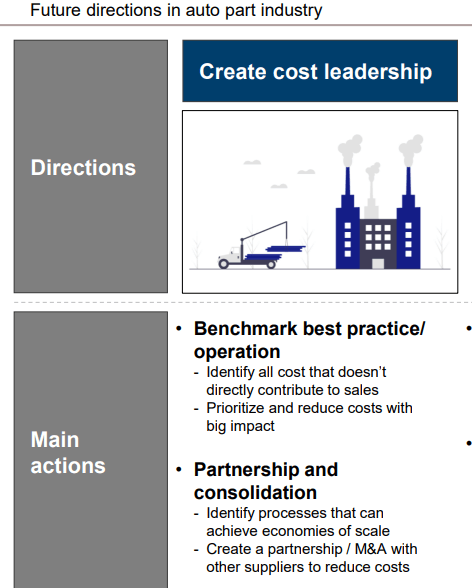
Therefore, entrepreneurs should start the actions by reducing unnecessary processes that will make their business operations more flexible in order to increase the competitiveness and begin to come up with a plan to cope with a long-term uncertainty like starting to invest in new businesses early, using their existing potentials to produce new products that meet the market needs.


