

WATCH: DIGITALLY ENABLED EFFICIENT PROPELLER BLADE ENTERS PRODUCTION PHASE
Project milestone reflects growing global momentum behind WAAM, as DEEP Manufacturing expands international production capability
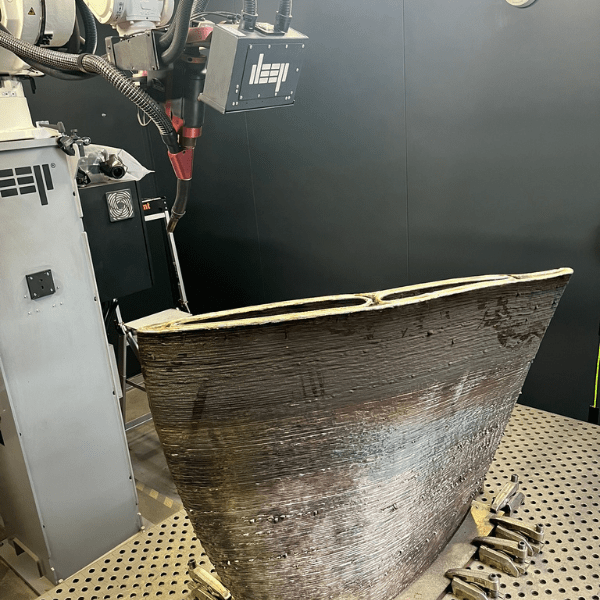
Printing is now completed on a section of next-generation, digitally enabled marine propeller blade, marking a major milestone in the Digitally Enabled Efficient Propeller (D.E.E.P) project.
The seven-month programme is demonstrating how industrial-scale additive manufacturing can unlock lighter, smarter and more efficient propulsion systems for the future of clean shipping. The propeller is made from Nickel Aluminium Bronze (NAB) using the process of wire arc additive manufacturing (WAAM). Timelapse footage has captured the blade taking shape – offering a rare insight into the additive manufacture of large-scale marine propulsion components.
Traditional propellers are typically produced using casting processes, which can restrict design flexibility and limit performance optimisation. D.E.E.P is investigating how industrial 3D printing can overcome these constraints, enabling lighter, more efficient and more intelligent propulsion systems designed for the future of clean and smart shipping.
At the centre of the project is a structurally and hydrodynamically optimised blade architecture. This approach offers lighter, more efficient blades while allowing real-time data collection. In time, this could allow vessels to monitor propulsion performance in real time, autonomously optimise engine power and speed, and enable predictive maintenance.
Led by Enki Marine Ltd – responsible for system integration and commercialisation – the consortium includes DEEP Manufacturing Ltd, Stone Marine Propulsion, TWI, Authentise, ASTM International and Newcastle University – spanning expertise in design, materials testing, digital workflows, certification and hydrodynamic validation.
Mr. Peter Richards, CEO at DEEP Manufacturing Ltd – which is overseeing the manufacturing processes and production scaling – said: “This is the point where digital ambition becomes physical reality. We are not simply printing a propeller – we are demonstrating a new way of thinking about propulsion design, production and long-term resilience.
“As we continue to scale our WAAM capabilities internationally, including our recent expansion into Houston, we are seeing first-hand how demand is growing for faster, more flexible manufacturing of large-scale, high-integrity components across critical industries.”


